Full-Stack Systems · 7 min read
Multi-Tenant SaaS Architecture: Designing Secure, Scalable Business Platforms
Design a multi-tenant SaaS platform with tenant isolation, authorization, PostgreSQL data boundaries, background jobs and audit trails.
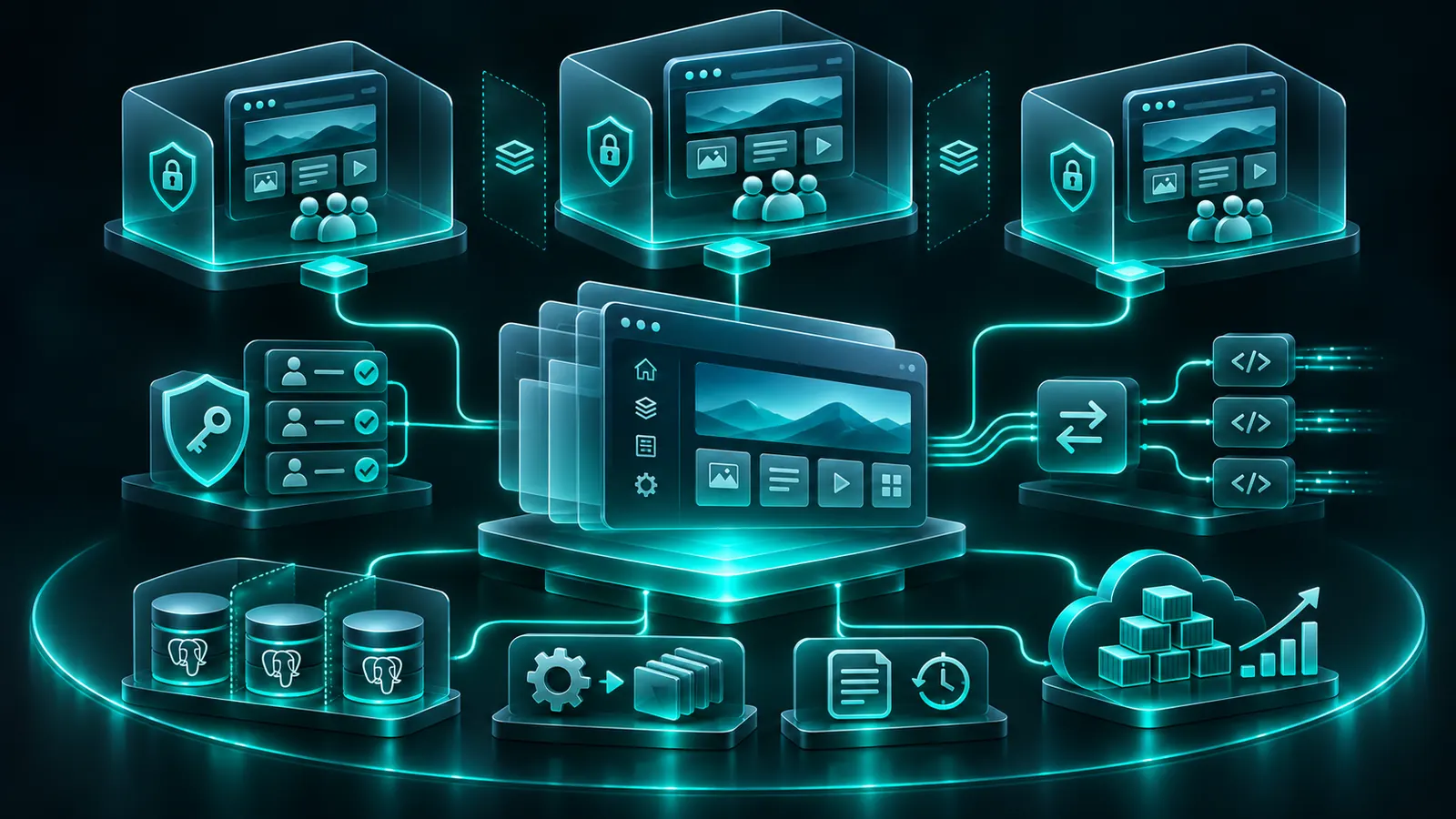
Sharing infrastructure between customers reduces operational overhead, but it also makes isolation a first-class security requirement. Decide whether each tenant receives a separate database, a separate schema or shared tables with tenant identifiers. The right choice depends on regulatory requirements, expected customer size, operational capacity and the cost of mistakes.
Choose the data boundary deliberately
Shared tables are often the simplest starting point, provided every tenant-owned record carries a tenant identifier and every query enforces it. PostgreSQL row-level security can add defense in depth, but it does not replace application authorization. Separate databases offer stronger operational separation at the cost of migrations, connection management and reporting complexity. Document the trade-off before writing the first migration.
Identity is not the same as tenancy
A user may belong to several organizations and hold different roles in each. Resolve the active tenant from an authenticated membership, not from an arbitrary client-supplied header. Authorization should evaluate the actor, tenant, resource and requested action. Test cross-tenant access at API, service and database layers, including exports and search endpoints.
Make tenant context explicit in background work
Queues and scheduled jobs are common places for tenant isolation to disappear. Every job payload should include an immutable tenant context and a stable job identifier. Workers must recheck permissions or service authority before performing side effects. Retry policies, dead-letter queues and per-tenant quotas prevent one customer's failing integration from consuming the entire system.
Build an API contract that survives change
Frontend screens evolve faster than data models. Keep validation, pagination, consistent errors and versioned response contracts at the API boundary. Use idempotency keys for creation flows that users may repeat. An audit trail should record the actor, tenant, action, timestamp and relevant before-and-after identifiers without copying sensitive content unnecessarily.
Plan for uneven growth
Tenants rarely generate equal traffic. Instrument database latency, queue age, storage and request rates by tenant, then enforce fair-use limits where needed. Use indexes that reflect tenant-scoped queries. Introduce caching with tenant-aware keys and invalidate it when permissions or data change. Scale the bottleneck observed in production, not the one imagined during architecture planning.
Operational safeguards matter
Backups must be tested for restoration, not merely scheduled. Migrations should be reversible where practical and compatible with rolling releases. Define how to export or delete one tenant's data without disturbing another. Include tenant isolation tests in CI, especially for newly added tables, background workers and administrative endpoints.
A concrete tenant-scoped query pattern
Suppose an appointments table contains tenant_id, patient_id and scheduled_at. The service must derive tenant_id from the authenticated membership and include it in every query predicate, including updates and deletes. A lookup by appointment ID alone is not sufficient. Tests should create two tenants with overlapping identifiers and verify that neither can retrieve or mutate the other’s records.
Tenant-aware caching and search
A cache key such as patient:42 is unsafe when identifiers are only unique within a tenant. Include the tenant boundary and relevant authorization version in cache identity. Search indexes, exports and analytics pipelines need the same isolation guarantees as primary SQL queries. Cross-tenant leaks often arise in secondary systems because they were treated as infrastructure rather than application data.
Use explicit service identities
Background workers and integrations may act without an interactive user session. Give each service a constrained identity, purpose and tenant scope. Log whether an action was performed by a person, an automated workflow or an external provider. This makes audit records useful during incident response and prevents broad administrative tokens from becoming the default integration mechanism.
Plan tenant migrations and deletion
A tenant may need a new data region, a dedicated database or a complete export. Design stable tenant identifiers and migration tooling before this becomes an emergency. Data deletion must cover attachments, caches, search indexes, queued jobs and backups according to a documented retention policy. A database row deletion is not a complete offboarding process.
A pragmatic first release
Start with a shared PostgreSQL database, tenant-scoped tables, centralized authorization and integration tests for isolation when requirements permit. Add row-level security as defense in depth. Move selected tenants to dedicated infrastructure only when justified by compliance, performance or contractual needs. Complexity should follow a measured requirement, not precede it.
The scalable choice
A secure multi-tenant product is not the one with the most elaborate infrastructure. It is the one whose isolation rules remain obvious and enforceable as new features, workers and integrations arrive.
Connection pooling and row-level security
PostgreSQL row-level security is useful defense in depth when an application shares tables. Yet its policy only works when the effective database role and active tenant context are trustworthy. With pooled connections, session variables can accidentally survive into another request if they are not reset. Prefer transaction-scoped context, test pool reuse explicitly and keep a restrictive application role. Administrative bypasses should live behind separate, audited service paths. Treat the database policy as another barrier, not the whole authorization system.
Transactional boundaries for business workflows
A business workflow may update a case, create a task and enqueue a notification. Decide which changes must succeed together. Write database state and an outbox event in one transaction, then let a worker deliver the external message. This avoids the classic failure where the database commits but an API call times out before anyone knows whether the message was sent. A worker can retry the outbox record safely when the receiving provider supports idempotency. Keep the resulting state visible to the operator.
A concrete tenant-safe repository contract
A repository function should accept a tenant context explicitly: getCase({ tenantId, caseId, actorId }). Do not create helper methods that fetch by record ID alone and depend on every caller remembering a later ownership check. Include the tenant identifier in composite indexes and in structured logs, but never expose raw access tokens in those logs. Recheck authority before every write, including delayed jobs whose original user may have lost access since the job was queued.
Onboarding, quotas and noisy neighbors
Even a well-isolated database can have shared resource exhaustion. Create tenant-aware limits for storage, requests, scheduled jobs and integration retries. During onboarding, provision policies and default roles in one idempotent operation and keep an audit record of the change. Measure the longest queue wait and highest request latency for individual tenants rather than hiding them inside global averages. That gives the team evidence for deciding when a large tenant needs a dedicated resource pool.
Schema evolution without tenant incidents
Schema changes must be tested against realistic tenant data sizes. Add new nullable columns, backfill in batches, deploy compatible readers and writers, then make constraints stricter in a later release. Run migrations as controlled deployment operations, not ad hoc requests from the admin UI. If one tenant has millions of rows and another has twenty, a single locking update can affect the whole service. Observe database locks, migration duration and replication lag before declaring a release finished.
Audit trails and sensitive information
A useful audit event records who changed what and under which tenant, but it should not duplicate whole medical, financial or personal records into an unbounded log. Prefer stable resource identifiers, field names and carefully redacted before-and-after summaries. Provide retention rules and restricted access for audit queries. Investigations should be possible without turning the audit system itself into a second, poorly protected data store.
Related engineering notes
For more on the connected decisions, explore Full-stack platform structure, Reliable API design, Background jobs and webhooks.